

Debugging the DockFrame Dual USB Card
When we connected the first Dual USB Card prototype directly to a laptop, the host didn't detect it. We started with the power-up circuit before moving on to firmware and the SuperSpeed signal paths.
We used one of the five prototype boards for bring-up, keeping the other four untouched. A couple of days of focused debugging later, USB3 is now confirmed at 5000M!
Our team designed the card's schematic and PCB layout in-house, and we're handling the prototype bring-up and validation ourselves. We're now continuing device and reliability testing while preparing for the DockFrame Crowd Supply launch.
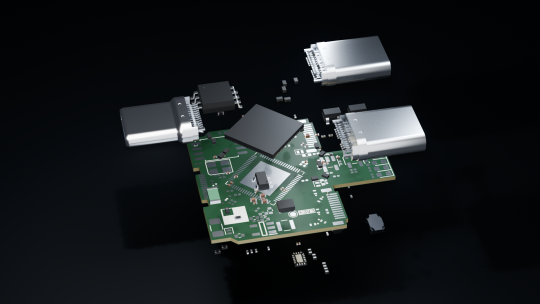
For anyone arriving here without the backstory, DockFrame is our modular dock for Framework-compatible Expansion Cards. This is the Dual USB Card, also called the Mini Hub. It gives you two downstream USB-C sockets from one upstream connection, so you can connect a drive without unplugging the other device you're using.
The card uses a Genesys GL3523 controller on a six-layer PCB. Both downstream sockets share its 5 Gbps upstream link; they're not two independent 5 Gbps connections back to the computer.
Getting the controller to enumerate
The initial investigation focused on the controller's power rails. We checked the measurement points against the schematic and used ground-referenced readings to distinguish a missing supply from a zero-volt difference between two supply nodes.
Our review of the assembly files identified R4, a zero-ohm link in the controller's 1.2 V supply and feedback path, as marked not to be fitted. Leaving that connection open interrupts both the core supply and the regulator feedback, making it an important finding in the startup investigation.
Following the power-path rework on the trial board, the status LED came on, we measured 3.3 V and 1.2 V, and the host detected a Genesys hub.
The connection was still at 480 Mbps, but we now had USB communication and could investigate the controller directly. The bench rework remains subject to our internal power-circuit review before it is carried into a production revision.
Testing the firmware
The GL3523 uses external flash, and a configuration qualified for our specific two-port layout was still pending. We needed to separate a firmware-programming issue from a problem with the SuperSpeed connection.
Using the Genesys support in fwupd, we ran a firmware A/B trial from Fedora. Version 65.06 connected at 480 Mbps; version 65.08 gave the same result.
We verified the programmed contents by reading the flash back and tested each image after a full unplug and reconnect. Both images were booting correctly, but neither produced a SuperSpeed connection in those tests.
That gave us a useful result: the firmware writes were working, so repeating them wasn't the next useful test. We restored the 65.08 baseline and returned to the hardware investigation. Board-specific firmware qualification remains part of the production work; the research images were not a final configuration for this card.
Checking the upstream connection
USB2 and USB3 use separate signal wires. A hub can enumerate over USB2 even when its SuperSpeed paths are not working, so the 480 Mbps connection didn't establish that the transmit and receive pairs were correct.
We identified an extra pull-down, R2, on the upstream plug's VCONN contact and removed it from the trial board. Our review also flagged a transmit/receive mapping issue in the board files. We documented the proposed correction in our bring-up notes for internal design review.
5000M, at last
We can now confirm USB3 detection at 5000M. The prototype has progressed from no host detection to a negotiated 5 Gbps connection.
That's the link-speed milestone we were working toward. The next step is to establish repeatable operation with real devices, not just a successful entry in the USB device list.
Our remaining tests cover reconnects, both plug orientations and devices in either downstream socket, followed by simultaneous use of both ports. Longer transfers will let us check for data errors, unexpected disconnects and temperature changes. A 5 Gbps link indication is not itself a file-transfer benchmark.
We're also documenting the final trial-board changes and completing the board-specific firmware configuration. Verified corrections will feed back into our production files as validation progresses.
Thanks to PCBWay
A thank-you to PCBWay for their great PCB services and for helping us fine-tune the impedance. Their manufacturing input on the stackup and routing geometry has been valuable throughout the development of this six-layer board. We appreciate the support.
Support Us on Crowd Supply
We're on Crowd Supply, and we need your help to bring DockFrame to more people. Your backing makes it possible to keep prices low and quality high, so everyone can enjoy the power of an open-source modular USB Hub ecosystem.

Check out the campaign and get involved: DockFrame on Crowd Supply
